



BOLT TENSIONING
Bolt Tensioning is a precision bolting technique used to achieve and accurately control the preload of a bolted joint by applying a predetermined tensile force to the bolt. Unlike conventional torque tightening, bolt tensioning stretches the bolt directly, producing a more accurate and uniform clamping force while minimizing the effects of friction.
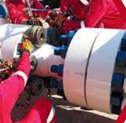
The process is performed using hydraulic or pneumatic bolt tensioners, which apply an axial force to elongate the bolt to the required tension. While the bolt is held under load, the nut is tightened against the flange surface. Once the hydraulic pressure is released, the bolt attempts to return to its original length, generating the required preload that securely clamps the joint together.
One of the key advantages of bolt tensioning is its ability to apply uniform and consistent preload across multiple bolts simultaneously by connecting several hydraulic tensioners in a single operation. This ensures even gasket compression, improves joint integrity, and significantly reduces the risk of leakage in critical flange connections.
Bolt tensioning is particularly beneficial for large-diameter, high-strength bolts and applications where access to the bolt head is limited. The technique also minimizes bolt torsion, reduces the likelihood of thread damage, and provides greater accuracy and repeatability compared with conventional torque tightening methods.
Bolt Tensioning is widely used during the installation, maintenance, and shutdown of critical equipment such as pressure vessels, heat exchangers, pipelines, valves, compressors, turbines, and offshore structures. Its precision, reliability, and ability to deliver leak-free flange joints make it an essential bolting solution for the oil and gas, petrochemical, power generation, marine, and heavy industrial sectors.